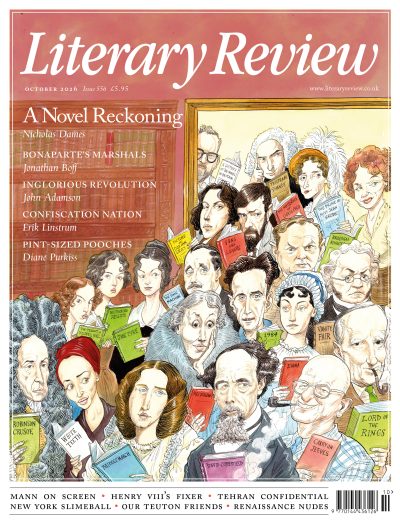
October 2026, Issue 556 Nicholas Dames on British novels * Jonathan Boff on Napoleon’s marshals * John Adamson on the Glorious Revolution * Diane Purkiss on small dogs * Erik Linstrum on the history of confiscation * Ritchie Robertson on Thomas Mann * Peter Marshall on William Paget * Adam Sisman on Cold War spies * Josh Glancy on Roy Cohn * Ferdinand Mount on Anglo-German relations * Norma Clarke on Lavinia Fontana * Dmitri Levitin on collaborative authorship * Joseph Hone on bookselling * D J Taylor on John McGahern * Piers Brendon on America and the Middle East * Anthony Teasdale on Europe * Tim Richardson on William Morris * Fergus Butler-Gallie on wine * Ian Thomson on peasants * Joan Smith on pornography * Joanna Kavenna on doubles * Madeline Zehnder on little books * Maria Margaronis on Barbara Kingsolver * Paul Genders on Marlon James * and much, much more…
The Current Issue
Nicholas Dames
A History of the Novel in Britain
By Philip Hensher
Along time ago, in the far-off 1990s, a mentor warned me that the subject I’d proposed to study, the Victorian novel, was fast approaching its expiration date. Soon enough, he said, its eye-straining bulk would set behind the horizon of cultural memory, following its 18th-century predecessors into antiquarian darkness. It was partly a numbers game, he explained: when the odometer clicked over and the 20th century squatted between the Victorians and us, they would become the-thing-before-the-thing-before, distant and inscrutable. Likewise, not so very long afterwards... read more
More Articles from this Issue
Jonathan Boff
Napoleon and his Marshals: Victory, Rivalry, Betrayal
By Andrew Roberts
The tale of the unknown Corsican soldier who rose from nothing to the throne of France, and conquered Europe from the Pyrenees to the gates of Moscow, only to lose it all, is an epic of such drama that, in over two hundred years, only one person has managed to make it boring. Heaven knows how Ridley Scott managed... read more
John Adamson
The Last Invasion of England: 1688 and the Dutch Armada
By Arthur der Weduwen
Much is exceptional about the Bayeux Tapestry currently on magnificent display in the British Museum, but nothing is quite so exceptional as the event itself. As the museum’s website reminds us, 1066 ‘was the last time England was successfully invaded’. Our sea-girt immunity from foreign invasion has been at the centre... read more
Erik Linstrum
The Age of Confiscation: Making and Taking Property in the Creation of the Modern World
By Nicholas Mulder
Do states exist to protect private property? It’s a familiar idea, especially in the English-speaking world, and often credited to philosopher John Locke (1632–1704). In the Second Treatise of Government, published in 1690, Locke outlined his version of the social contract... read more
Diane Purkiss
Yap!: A Short History of Small Dogs
By Stephanie Howard-Smith
Looty. Pimperl. Jupiter. Masterpiece. Cherry. Miss Candyfloss. Purkoy. Sappho. Lady Anderson. Diamond Baby. These are the names of cherished small dogs of the kind that belonged to queens including Anne Boleyn and Mary, Queen of Scots. If some of the names suggest prostitutes, sex toys or young children, that is as it should be, because, as this entertaining... read more
Peter Marshall
King’s Secretary: William Paget and the Last Years of the Reign of Henry VIII
By Andrew Johnston
Tudor history buffs and attentive readers of Hilary Mantel’s Wolf Hall trilogy will recognise the name William Paget. Others will require some words of introduction. Paget (1505/6–63) was an able and influential diplomat and administrator who rose to become principal secretary to Henry VIII... read more
Josh Glancy
American Scoundrel: Roy Cohn’s Dark Journey from Joe McCarthy to Donald Trump
By Kai Bird with Susan Goldmark
Perhaps the most revealing Roy Cohn anecdote in this extraordinary book concerns the time, in 1955, when the infamous lawyer took Barbara Walters out on a first date. Cohn picked up the TV star in his car and drove her to the 21 Club in midtown Manhattan. The traffic was awful... read more
Most Read
moreJessica Mann
March 2010 Crime Round-up
David Bodanis
Prize Fight: The Race and the Rivalry to be the First in Science
By Morton A Meyers
Kathryn Hughes
Anita Brookner: Art and Life
By Hermione Lee
Adrian Weale
Black Hearts: One Platoon’s Descent Into Madness in Iraq’s Triangle of Death
By Jim Frederick
Claire Harman
Who’s In, Who’s Out?
From the Archives
moreFrom the March 2020 issue
Peter Conrad
Warhol: A Life as Art
By Blake Gopnik
From the August 1995 issue
Syrie Johnson
Small Holdings
By Nicola Barker

From the June 1999 issue
Christopher Hitchens
Some Times in America
By Alexander Chancellor
Back Issues
more
September 2026

August 2026
Sign Up to our newsletter
Receive free articles, highlights from the archive, news, details of prizes, and much more.@Lit_Review
Follow Literary Review on Twitter
Twitter Feed
Literary Review
@Lit_Review ·Small, useless and endlessly loved, lap dogs have stood for frivolous femininity and the witch’s familiar hidden in her lap.
Diane Purkiss wonders what our relationships to these animals say about us.
Diane Purkiss - Fur from Reasonable
Diane Purkiss: Fur from Reasonable - Yap!: A Short History of Small Dogs by Stephanie Howard-Smith
literaryreview.co.uk
Literary Review
@Lit_Review ·Roy Cohn prosecuted the Rosenbergs, served as Joseph McCarthy’s chief attaché and later counting Donald Trump, mafia dons and Studio 54 regulars among legal clients.
@joshglancy considers what, if anything, Cohn actually believed in.
Josh Glancy - Give Me the Judge
Josh Glancy: Give Me the Judge - American Scoundrel: Roy Cohn’s Dark Journey from Joe McCarthy to Donald Trump by Kai Bird with Susan Goldmark
literaryreview.co.uk
Zoe
@zoeguttenplan ·The October issue of @Lit_Review is bursting with good stuff. There's @n_j_dames on the British novel, @ErikLinstrum on the history of confiscation, @FlorenceHallett on sculpture, @josephcoward on Ben Eastham and so much more: https://literaryreview.co.uk